 My partner was diagnosed with ovarian cancer this past March. The cancer cells must have been festering, but for our family, her illness began with a cold and then a persistent cough. From the 10,000 foot view, the whirlwind was three long weeks: repeatedly take fluid out of her lungs; she has lung cancer; no, she has stage 4 ovarian cancer; unzip her belly and remove all her "girly parts." Bam.
This is not a way of life that I have chosen. There has been a fissure, a rupture in our lives. It will never be the same. Life always changes. But this is not a good change. It is bad. Very bad. It isn't fair. Life isn't fair.The emotions swing, in and out: pragmatism vs. "bigger picture" reality; absorbed by daily life details, then overcome by what this cancer really means (as though I actually know).
I am lonely. I want comfort. I want someone to understand. I want someone to know how it feels. We are so unlucky.In March, I became the primary caretaker for two: our eleven year old son also needed attention. I coordinated friends and family to pick him up, drop him off, or stay with him until I came home. I always came home--I didn't want to disrupt his life any more than it need be. He felt uncomfortable talking, really opening up, to anyone other than me. I became his confidant, helping him understand in his own terms what he needed to, and protecting him from what a child oughtn't face. Certainly I couldn't confide in him, but neither could I confide in my partner. For both, I had to be strong.
First, the lightning bolt showed me she was going to die. How could our time together be cut short, so suddenly? Soon after: she could have died in surgery when they took her away from me for hours and hours. I realized how much my life was bound with hers and our son's. What would we do without her?Deep worries and desires like these subside. Then, like a flash flood rushing through a canyon, they carry me away. Struggling to surface, I need something to give me breath.
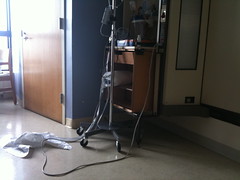
I want someone to realize that my partner having cancer still has an enormous impact on me, as well as on our lives.I don't think about "she could die" anymore. But I live with the threat that she could end up in the hospital again: blood pressure, temperature, oxygen saturation, pills, shots, IVs, draining tubes, x-rays, CT scans, MRIs; not knowing where she is in the hospital, when they're going to be done, or if they're going to figure out what's wrong. Not knowing.
 By May, life was pretty much back to normal. We were back to being busy working parents, scrambling for time to discuss who was picking up whom, from where, when. On Memorial Day, we walked along with our son's band in the parade. I left her to go talk to someone across the street. I saw her leaning against a fence, looking tired, but okay. The friend and I walked along together for several blocks. Suddenly, I couldn't find her. She wasn't across the street. I couldn't see her in front of me or behind. The possibilities ran through my head. I wasn't overcome with panic. I was stepping through: if she had fainted, maybe someone had let her sit in a lawn chair and given her some lemonade. Or, maybe she was in an ambulance. Maybe we would end up sitting for hours in the hospital again. I ran back along the parade route. I called her cell phone: no answer. I found myself in front of our car, so drove it back to the fence where I'd seen her last: she wasn't there. Finally, I went to the end of the route and there she was, calm as could be, asking where I'd been. Innocently. As if she hadn't fainted; no one had offered her a sip of refreshing lemonade; the ambulance hadn't come.
She asked where had I been? She was the one in danger.
She doesn't, can't, understand how the illness makes me feel. Nobody understands how it makes me feel. The threat is always present; the Caretaker is always aware. The reason I stay calm in the emergency, concentrate on what the doctors are saying, ask careful questions, enable us to make critical decisions, is because I anticipate what will happen next. I have thought through the mights.
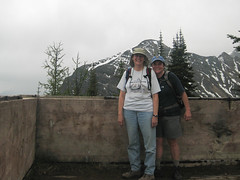 In June, we did what we love to do: we hiked up a mountain. Sure, she had a little trouble breathing, but she turned on the "little engine that could" that has always lived inside, and chugged right up. We felt triumphant. I saw life progressing, moving forward slowly but surely.
I should have noticed. I should have gotten her out of the sun earlier.I fanned her with my hat. The police officer offered water and ice wrapped in a towel. I worked through the possibilities: she was having trouble breathing again, or the chemo was making her more susceptible to heat, or . . . what? She would lie on the stretcher. They would give her oxygen. If they treated her at all, would they be required to take her to the hospital?
I live with the threat that any health issue could turn serious at a moment's notice. I live with the burden of letting her live her life the way she wants to, yet knowing that she won't ask me for help until it's past the time when she needs it, because that's part of her living her life. She is resolutely self-sufficient, then needy; she tells me I'm nagging, then allows me to help.
I must stay vigilant. I let down my guard to watch my soccer team. I deserved to. I shouldn't have. I'm supposed to be a caretaker. And I'm not.
Something could happen. She could go to the hospital. Something bad could happen. At any time. It all starts with heat stroke, breathing with difficulty. Anything.My fear is always here. Lurking. I seem to live with it, ignorantly, as a hiker unaware that hard rain in a canyon may bring flash floods.
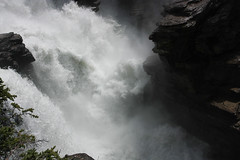 And then the rains come. The canyon floods.
Please, give me breath.
I know you're out there. I know you know how it feels.
Labels: cancer, Kim Brookes